Build a Successful Identity Management Program
Explore how leading institutions are building scalable IAM programs and identify what is holding yours back.
Turning Identity Complexity into a Scalable Strategy
A practical framework for managing identity, access, and security across decentralized campus environments
Higher education institutions operate in complex environments with decentralized systems, constantly changing user populations, and increasing demands for secure access.
As identity becomes the primary attack surface, institutions need more than tools. They need a structured Identity and Access Management (IAM) program that brings consistency, governance, and scalability across the organization.
This page outlines a proven approach to building and maturing an IAM program in higher education.

What is Identity and Access Management (IAM) in Higher Education?
Identity and Access Management (IAM) enables universities to securely manage access to systems, data, and applications across complex, decentralized environments.
It is the foundation for protecting institutional data while enabling collaboration, research, and digital learning.
The Higher Education Identity Challenge
Most identity programs in higher education fail for the same three reasons: lack of governance, fragmented tools, and manual processes that do not scale.
Higher education identity environments are inherently complex:
- Decentralized IT environments across departments and systems
- High identity turnover across students, faculty, staff, and alumni
- Expanding digital platforms and cloud adoption are increasing risk
These challenges often lead to:
- Technical debt from fragmented identity tools
- Manual processes that do not scale
- Lack of centralized governance and ownership
.png?width=450&height=300&name=Untitled%20design%20(16).png "Students on campus")
What This Complexity Creates
- Technical debt from fragmented identity tools
- Manual processes that do not scale
- Lack of ownership and governance
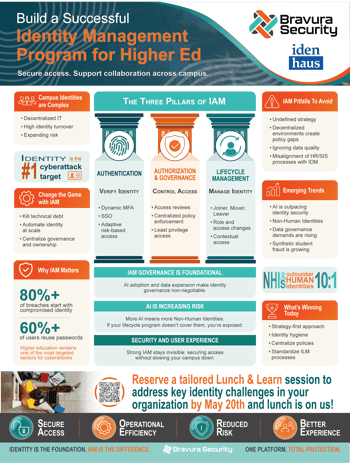
The Three Pillars of IAM
A strong identity management program is built on three foundational pillars:
-1.png?width=500&height=500&name=Untitled%20design%20(1)-1.png "Untitled design (1)-1")
Authentication
Verifying identity
- Multi-factor authentication (MFA)
- Single sign-on (SSO)
- Adaptive and risk-based access
Authorization and Governance
Controlling access
- Access reviews
- Centralized policy enforcement
- Least privilege access
User Lifecycle Management
Managing identity over time
- Joiner, mover, leaver processes
- Role and access changes
- Contextual access and automation
What Success Looks Like
A mature IAM program enables:

Secure Access
Secure, scalable identity and access management

Operational Efficiency
Reduced operational burden through automation

Reduced Risk
Condistent, policy-drive access control

Better Experience
Improved user experience across campus
IAM Governance is Foundational
Effective IAM programs depend on strong governance.
As institutions expand data access and adopt AI-driven technologies, identity governance becomes non-negotiable.
Clear policies, ownership, and accountability ensure:
- Consistent access control
- Regulatory compliance
- Secure and responsible use of institutional data
Common IAM Pitfalls
- Undefined identity strategy leading to inconsistent outcomes
- Decentralized environments creating policy gaps
- Misalignment between HR, SIS, and identity processes
- Legacy and homegrown systems slowing progress
Emerging Identity Trends
- AI adoption is outpacing identity security capabilities
- Non-human identities are increasing rapidly
- Data governance demands continue to grow
- Synthetic identity fraud is emerging as a risk
As AI and automation expand, identity is no longer limited to users.
- Non-human identities are growing rapidly
- Access to systems and data is expanding beyond traditional users
- Identity lifecycle programs must evolve to include these identities
Without proper governance and lifecycle coverage, risk increases significantly.
Why Identity Management Matters
- 80%+ of breaches involve compromised identities
- Higher education remains a top target for cyberattacks
- Identity is the foundation of secure access to data and systems
What is Working Today
Leading institutions are prioritizing:
-
Strategy-first IAM programs
- Identity hygiene and governance
- Centralized policy management
- Standardized lifecycle processes
Get Your IAM Program Off The Ground
Book a Lunch & Learn!
Enjoy lunch on us while you explore how leading institutions are improving identity security and efficiency.
Request a private, hands-on session tailored to universities, colleges, and community colleges and designed to deliver practical value—no sales pitch, just actionable insight.
We’ll guide you through evaluating your current identity infrastructure, uncovering hidden risks, and identifying clear next steps to build a stronger, more scalable program.
Build an IAM Program That Scales With Your Institution
Higher education environments are inherently complex, with decentralized systems, constant user turnover, and growing demands for access. The challenge is not a lack of tools. It is building the structure, governance, and strategy needed to make them work together.
This session shows you how to do exactly that and how to create an IAM program that grows with your institution.
In this session, you will learn how to:
- Identify the biggest gaps in your current identity program
- Reduce technical debt from fragmented tools and scripts
- Move from manual processes to scalable automation
- Establish governance and ownership that drives consistency
- Standardize access across decentralized environments
- Support federated identities and multiple user roles
- Prepare for AI-driven identity challenges and non-human identities
Find Your Biggest Identity Gap and What to Fix First
Terms and Conditions for Complimentary Team Lunch Offer
- Eligibility: The offer is valid exclusively for Identity and Access Management (IAM) or cybersecurity teams. All team members must be employed within the same organization
- Mandatory Attendance: To be eligible for the complimentary lunch, at least one member of the IAM team must attend.
- Lunch Distribution: The complimentary lunch will be provided in the form of an online food delivery service voucher on the day of the event. It will be valued at $25 per person for up to 10 people.
- Offer Non-transferable: The complimentary lunch offer is non-transferable and cannot be exchanged for cash, credit, or other services.
- Limited Availability: The offer is subject to availability and may be limited to a certain number of teams or participants as determined by the event organizers.
- Please note that additional terms and conditions may apply. Participants are encouraged to review all event documentation for further details or contact the event organizers for any clarifications


Request a Demo Today
Ready to take your institution's IAM strategy to the next level?
Request a demo today and see how our solutions can tailor to your university's or college's specific needs.